Home Blog Page 37

How To Bring Your Foodie Lifestyle to Off Grid Living

According to the Conservation Institute, over 1.7 billion people are living off grid, or not relying on public utilities like water or electricity. If you’re considering converting to off grid living and leading a more environmentally friendly lifestyle, it’s important to keep in mind that you don’t have to sacrifice good, high quality food along the way. From the benefits of growing your own vegetables to sourcing your own water, here’s what you need to know in regards to successfully maintaining your foodie lifestyle.

Clean water for quality cooking

There’s no doubt that water plays a vital role in cooking high quality food, whether you’re boiling a hearty soup, poaching an egg, or creating a spectacular sauce. However, when living off grid, sourcing your own water might seem like one of the most difficult things to do, though there are a myriad of options to choose from. Well water, for instance, is perhaps one of the most common sources of water for off grid living, though if you’re not near one, it can be expensive to install one. On the other hand, natural springs, while not common, are another great solution for fresh water. If these aren’t available to you, buying your water and transporting it to where you’re living is yet another accessible option, as it can be purchased in a large tank (thus making it more convenient if all else fails).

The benefits of growing your own food

Growing your own fruits and vegetables is another great perk of living off grid, and presents numerous benefits of its own that contribute to both an eco friendly and healthy lifestyle. In this way, not only will you know exactly where your produce comes from, but you can ensure you’ll be getting the freshest produce possible that you’ll need for even the most complex dishes. Another benefit is that home grown produce also tends to be more healthy due to it containing more nutrients. This is primarily due to the fact that the majority of produce that is sold in grocery stores has to go through a long process of harvesting, shipping, and distribution, where it then sits in storage or on the shelves – thus causing it to lose nutritional value over time.

The equipment you’ll need

While you obviously won’t have access to a five star kitchen, living off grid can present the unique opportunity to use other styles of cooking that can produce just as good of a result. For example, learning to cook on an open fire can present a learning curve (which is why it’s important to get some practice in before making a full meal), though you’ll learn valuable insights along the way – such as how it’s better to cook over glowing coals rather than actual flames, since the heat will be more stable. Other off grid cooking methods involve the use of a BBQ grill, a wood burning stove, or even a solar oven, each that come with their own learning curve and ability to suit a myriad of different gourmet dishes.

Although continuing a foodie lifestyle while transitioning to off grid living can seem like a lost cause, there are actually a number of ways that you can create healthy, gourmet dishes. From sourcing your own water to growing your own food and investing in the right equipment to cook with, you’re sure to learn a great deal about the art of cooking off grid.

Tips for Designing an Eco-Friendly Kitchen

Sustainability is a buzzword among consumers across the globe, reports IBM. Consumers “increasingly embrace social causes and seek products and brands that align with their values.” The affinity for eco-friendly products is far-reaching. Not only does it cover kitchen and home design, but also food products, fashion, and other realms. If you are currently renovating your kitchen, how can you ensure it reflects the value of sustainability in your life?

Building Your Kitchen in Eco-Friendly Materials

For everything from flooring to splashbacks, you can make ‘green’ choices while also following the latest design trends. For your flooring, consider the following materials:

  • Forest Stewardship Council-approved wooden floors (which guarantee that the wood is harvested sustainably)
  • Salvaged wood floors (obtained from old homes or buildings)
  • Linoleum made from natural materials (including linseed oil, which boasts anti-microbial properties)
  • Cork, rubber, and concrete are also considered environmentally friendly.

When choosing materials for central islands and countertops, support brands that use renewable energy and recycled materials to manufacture their collections or choose inherently sustainable materials such as bamboo. For splashbacks, materials such as cork, recycled clay tile, or reclaimed wood tiles may do the trick.

Saving Energy in the Kitchen

The kitchen is one of the home’s most energy-consuming spaces. Appliances such as dishwashers, ovens, hobs, hoods, microwaves, hand blenders, and more consume energy on an almost daily basis. One of the main tenets of green home design is focused on energy savings and the use of renewable energy sources. When purchasing new appliances, watch out for those bearing recognized ratings such as Energy Star and WaterSense.

If you are using cooling in your kitchen during warmer months or heating during the cooler season, make sure your kitchen is well insulated so that air leaks don’t cause you to rely excessively on air conditioning or heating. Keep in mind that the cost to replace your furnace or air conditioner with a more energy-efficient unit will be recouped from the saving in the long term. Consider installing solar panels on your roof to generate the power you need to prepare magnificent meals without worrying about the electricity you are consuming. You can save up to $100 every month on your electricity costs by going solar.

Opting for Eco-Friendly Materials for Smaller Items

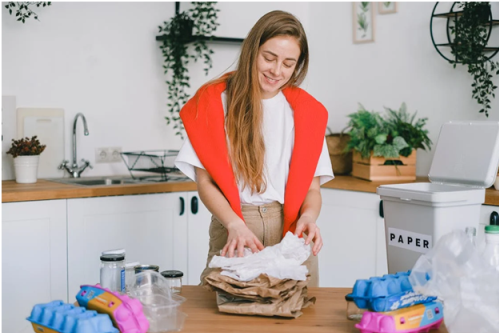
When buying items such as kitchen décor, chopping boards, bowl covers and the like, thinking before you shop can help lower your carbon footprint significantly. For instance, instead of using aluminium foil or plastic wrap to cover food before placing it in the fridge, consider reusable bowl covers (made of fabric with elastic edges) by companies like Wegreeco. For wooden items and décor, pick items made of reclaimed wood. Instead of paper towels, choose reusable kitchen towels. The latter can be used to clean up as well as to wrap foods such as bread instead of plastic. Instead of using plastic bags for foods like sandwiches, rely on silicone food bags, which are reusable.

To design an eco-friendly kitchen, plan everything from your flooring to tiny décor details with your carbon footprint in mind. Invest in energy-efficient equipment and, if possible, consider solar panels for your energy needs. Finally, choose materials that are recycled or fast-growing such as recycled wood and bamboo, which look good and sturdy enough to handle even the busiest family of cooks.

The Four Skills Every Home Chef Should Know

When I was first contacted by the “do my assignment” service to research some of the skills that every home cook should have, I didn’t know that I would find the subject so interesting. At first, I thought that the topic would involve telling home cooks what utensils to buy or how to care for their pots and pans. I didn’t know that there are a ton of things that home cooks could do to improve their cooking. I was so fascinated by the topic that I just couldn’t help myself and I had to write a compact version of the article I did so all of my readers could benefit from it.

Now that we know why we’re here, let me give you a few statistics about why this topic is so important. Approximately 36% of all Americans cook their meals daily, but only about 13.7% of those surveyed are doing so out of a strong passion for cooking. Most people are simply trying to make a delicious meal that gives themselves and their families the nutrition they need. As a result, not a lot of people are thinking about how they could improve their cooking. Fortunately for them, I’ve given it a lot of thought, and that’s why I’ve decided to write an article on some of the things that home cooks need to learn to improve their cooking.

Learn How To Save Your Bones For Broth

One of the first things that all home cooks should start doing immediately is saving their bones to make bone broth. Most people when they prepare meat for their nightly meal simply chuck any bones directly into the trash. They should stop doing that immediately. Instead, they should place the bones in a plastic freezer bag and freeze them. They can then use these bones at a later date to make a bone broth. Making a broth is easy. All you have to do is to rinse the bones, submerge them in a pot of water, add onions and/or herbs, and then boil it for 12-hours. When that’s done, the mixture is strained and the beautiful broth can be saved for up to 10-days to liven up dishes. If you want to keep it longer than that, all you have to do is to freeze it and save it for up to 6-months.

Learn How To Cook Pasta Properly

Learning how to properly make pasta can raise a person’s cooking to the next level. Most home cooks overcook their pasta until it’s a soggy mess, which definitely doesn’t result in delicious meals when tackling new pasta recipes. Properly cooked pasta is “al-dente,” a term that means “to the teeth.” What does that mean? That means that the pasta is soft, but is still firm when bit into. To achieve this pasta state, you should make sure that you bring the water to a boil before introducing the pasta to it. Once it’s boiling, add in some salt, and cook for 10-12 minutes. Be sure to stir the pasta regularly to prevent sticking, and then drain the pasta. That will result in perfect pasta. Of course, since there are different kinds of pasta, all with different cook times, it’s important to learn these cook times and cook your pasta accordingly.

Learn Some Basic Knife Skills

Something else that everyone should learn is some basic knife skills. Properly using your kitchen knives will not only allow you to expand the number of dishes you can make and improve your efficiency but having knife skills will also help keep you safe. Although professional chefs have a wide variety of different knife techniques to use while they cook, you don’t need to learn all of them. You really only need to learn how to slice, how to dice, how to mince, and how to cut. If you want to elevate your knife skills a little bit more, you can also learn how to julienne and chiffonade as well. There are a ton of videos on knife skills available that will teach you the basics in no time flat.

Learn How To Process A Whole Chicken

Learning how to cut up a whole chicken is a skill every home cook should know. Not only is it cheaper to buy a whole chicken than to buy individual chicken pieces, but processing your own can be quite satisfying as well. Besides, once you process your own whole chicken, you’ll have bones that you can use for making tasty, delicious stock.

Are Water Filter Systems Any Good?

We all want clean water, so why do so many people drink the stuff that comes out of the tap without looking at the alternatives? There are so many contaminants in tap water, which is why so many people are asking are water filter systems any good? It’s a valid question, and one we will explore in more detail.

So, What Are The Common Contaminants?

Any communal water source is going to be full of nasties that you will want to remove. The good thing about using a water filter is that they can make water safer by getting rid of, or significantly reduce the level of the likes of chlorine, arsenic, bleach, toxins, lead, pesticides, aluminum, and fluoride among many others.

It is important to find out what level of contaminants there are by using a test kit. However, there are ways to make sure your water is as clean as possible. Enter, a filter system.

So, Are Water Filter Systems Any Good?

The right brand and model is going to work wonders for the cleanliness of the water in a home, but we will get to that. In short, there are many benefits to use a water filter system, including the following:

Quality

We’ve just about covered this, but the overall improvement in quality will ensure that nasties are significantly reduced. This has a positive impact on a family’s health as the body does not have to remove toxins and the likes.

Taste

Ever been to someone’s house and tastes the water that comes from the tap. It’s not always pleasant and some have a distinct metallic taste and smell and can even have a chlorine taste to them.

Health

We touched on this but it deserves its own section. This is because a water filtration system is also good for skin hydration, digestion, absorbing nutrients, and much more. So, the purer the water the better.

Low Maintenance

Most reputable systems don’t require much attention and can be left to providing clean water without the need to do much else. The filters are easy to change and set up is usually convenient.

Saves Money

Anyone who drinks bottled water because they believe it is better for them than tap water might be right in that respect, but the price can be difficult to justify.  So, instead of spending $100’s a year on bottled water, a lot of people make the leap and enjoy the benefits of conveniently clean water.

Reduces Plastic Consumption

This is an environmental benefit, which is more important now than ever. Hundreds of millions of plastic bottles of water are sold every year. Being able to reduce this would have a positive impact on the world, and who doesn’t want to contribute to that and get better water out of it?

Easy To Install

This is where a lot of people are surprised. Reputable filter systems excel in this area. It doesn’t take long to install a water filter system at home, and because of the numerous benefits from one of the best in the business, it is easy to see why it is one of the most popular.

Weight Loss

Not only does consuming water help keep hunger pangs at bay, but it is also vital for hydration and an important part of a healthy lifestyle. The better the quality of water, the more benefit there is to the body.

Reduces Lime Scale

Ever wondered why the kettle keeps looking at the sorry state it does on the inside? This is to do with hard water, so removing it is going to be better for the water that you use to cook and the appliances that come into contact with it.

Food Tastes Better

That’s right, even cooking with filtered water brings out the best in the flavors. Contaminated water contains nasties that will strip the food of its benefits and flavor so to get the maximum taste and health benefits, go for a water filter system.

What Is The Best Type of Water Filter?

For us, the best type is a countertop water filter. These are great because they are convenient, easy to maintain, and do an excellent job of ensuring tap water is clean and healthy. Also, they are some of the most cost-effective solutions to bad tasting and contaminated filled water. For us, the best and most reliable brand is Berkey. It’s very easy to install a Berkey water filter system at home. They come in a variety of sizes for households that will use them more frequently, ensuring clean water is always available. Also, check here to see more information about a gravity water filter.

How Much Does A Water Filter System Cost?

This can vary greatly. For the real thing expect to pay around $300.

When considered the benefits, plus the savings of no more bottled water, these products pay for themselves before too long.

Mexico at Home: Shrimp Fajitas

Shrimp fajitas are one of my all-time favorite Mexican meals. Absolutely packed full of incredible flavors, the smell alone is enough to get my mouth-watering, and it’s the dish I always order when eating out at a Mexican restaurant.

I love this meal so much, I found myself spending an absolute fortune on shrimp fajitas any time my family went out to eat (and there have been more than a few takeaways over the years!). So, eventually, I realized that I needed to find a recipe to make at home.

After much scouring the internet and experimenting with different flavors and textures, I uncovered this delicious, authentic shrimp fajitas recipe. An immediate family favorite and a guaranteed crowd-pleaser, this delicious recipe can be made in just 15 minutes and is packed full of all the tasty flavors you’d expect from a tasty shrimp fajita. I love to go fully authentic by making my own tortillas to serve this with, or you could pour it over rice. And don’t forget the guacamole, cheese, and sour cream!

What makes these fajitas so good?

Seasoning: It’s the combination of spices in this recipe that makes it one of my all-time favorites. The garlic and onion are so delicious together and immediately fill the kitchen with irresistible aromas, while the light heat from the chili powder combined with earthy cumin is impossible to resist. A little oregano helps lighten the dish.

Onions: By sautéing the onions and letting them char a little bit, the acidity from the onions really helps bring out the sweetness of the peppers and the flavors from the seasoned shrimp.

Peppers: Do not just go for one bell pepper color. A variety helps keep the dish bright and colorful and creates a flavor sensation that’s hard to beat! Remember, green bell peppers are less ripe and slightly more bitter than yellow, orange, or red peppers. Red peppers offer the sweetest and fruitiest flavors.

Dietary requirements

This recipe is ridiculously easy to amend to suit almost any dietary requirement. See below for my top tips on simple adjustments:

Whole30 or Paleo diets: Instead of tortillas, serve your authentic Mexican shrimp over cauliflower rice.

Gluten-free: Serve your shrimp in gluten-free tortillas or over rice.

Low-carb or Keto diets: Check for low-carb tortillas or serve with cauliflower rice. There are only 4g net carbohydrates per serving of the filling, so it’s the accompaniment you need to watch out for on a low-carb diet.

Mexican shrimp fajitas recipe

Serves: 8

Prep Time: 5 minutes

Cook Time: 10 minutes

Total Time: 15 minutes

Ingredients

  • 1lb shrimp
  • 1 tsp garlic powder
  • 1 tsp onion powder
  • 1 tsp oregano
  • 1 tsp chili powder
  • ½ tsp cumin
  • 1 ½ tsp salt
  • 2 tbsp oil, divided
  • 1 large onion, halved, then sliced into ¼” strips
  • 3 bell peppers, various colors, sliced into 1/4” strips
  • 8-12 flour tortillas, to serve

Method

  1. Put your shrimp into a large bowl and toss with the garlic powder, onion powder, chili powder, cumin, and salt until thoroughly coated.
  2. In a cast-iron skillet, heat 1 ½ tbsp of oil. Once it starts to smoke, add the various colored peppers and onions and sauté until softened and slightly charred in places (around 5 minutes), then transfer to a plate.
  3. In the still-hot pan, add the remaining ½ tbsp of oil, then chuck in the seasoned shrimp and cook until each shrimp is just pink and opaque (2-3 minutes on each side).
  4. Put the onions and peppers back in with the shrimp, then cook everything together, stirring to evenly distribute.
  5. Once hot, remove the shrimp fajita filling from the pan and portion into tortillas or over rice and top with your favorite condiments (I love a generous helping of guac, sour cream, shredded cheese, and a squeeze of lime on mine, but feel free to experiment!).

Notes

I cannot get enough of these delicious Mexican shrimp fajitas, and they’re one of my most-requested dishes whenever I have friends or family over… Which is perfect, as they’re so quick and easy to make!

When I really want to impress, I love to bring out my Uno Casa cast iron tortilla press and make my own tortillas from scratch. I love doing this because homemade tortillas are unbelievably easy to master, but my friends and family always think I’m such a pro in the kitchen whenever I bring out 100% homemade shrimp fajitas! Sometimes I even make the guac and sour cream myself if I really want to wow.

How To Use A Mortar & Pestle Properly

Mortar and Pestle

One of the oldest cooking tools still in use today is the mortar and pestle, and there’s a good reason for that fact: they do an amazing job of breaking food items down. It doesn’t matter if you’re trying to crush nuts or seeds, or something different, these tools will help you get the job done. That’s why we’ve not only wanted to explore the history of these items a little bit more, but we also wanted to make sure that we help our readers discover how to use them properly. To anyone who wants to know more about these kitchen tools, come along with us as we explore them in-depth.

The History of Mortar & Pestles

No one really knows when the mortar and pestle were actually invented. It’s obvious that the idea of grinding a substance between two hard surfaces is likely over 100,000 years old or older. Many paleontologists believe that humans ground sorghum grass seeds between two rocks approximately 105,000 to 110,000 years ago in Africa. So, humans have been grinding seeds, nuts, and other foods between two hard surfaces for quite a long time. This was likely to make the seeds easier for the human body to break down and use the nutrients.

Mortar and pestles were invented sometime after that—somewhere over 3,000-years ago. These mortars were made from a variety of different materials such as wood, stone, and even ceramic. It was one of the first ways for people to grind grains, and it would later be used for pharmaceutical preparations such as the creation of salves, pastes, and other assorted medicines.

How To Use a Mortar & Pestle

Now that we understand that mortar and pestles are tools that have been used for thousands of years, it’s time to turn to the central premise of this blog post: how to use your best mortar & pestle. Let’s get started with the basics and move on from that point.

Choose The Best One Available

One of the first things that you should do is to pick the best mortar & pestle for your needs. We recommend that consumers purchase mortar & pestles that are made from stone, marble, or granite. While they’re also some good wood mortar and pestles available, wood is a porous material that will stain easily. Ceramic mortar and pestles are good for light grinding, but they’re extremely fragile, so they have to be used with extreme care. In our opinion, marble, granite, and other stone mortars and pestles are the way to go.

It’s also important to choose the right size. Make sure that it’s big enough for your needs. If you only intend on grinding a small number of seeds, then you likely don’t need a large mortar and pestle. On the other hand, if you need to do a lot of grinding, don’t try to use a small one because you won’t get good results.

Use It for the Correct Job

To get the best results, don’t try to use the mortar and pestle for something other than its intended purpose. These tools are designed for grinding or crushing things like fresh herbs, spices, grains, etc. They are not designed to chop, puree, or blend together ingredients.

Don’t Overfill the Mortar

The mortar, if you didn’t know, is the cup portion of these tools. They’re designed to hold the grains, herbs, or spices that are going to be ground. It’s important not to fill the mortar more than one-third full when using it to grind. This gives you enough space to manipulate the materials in the mortar and will help you get a better grind.

Use One Hand for the Mortar & One for the Pestle

It’s also important that you handle the mortar and pestle set properly. Hold the mortar in one hand to stabilize it while using the pestle with the other hand. Twist the pestle against the ingredients until they’re all the same consistency. If need be, rotate the mortar to make sure that you have access to all of the ingredients. By the time you’re done, all of the grains, herbs, or spices should be the same size.

Dump The Ingredients into A Bowl or Jar

Depending on whether you intend on using the ingredients you just used immediately, or if you’re going to store them for later use, it’s important to dispense them from the mortar immediately. The mortar should never be used to store spices, seeds, grains, or herbs. If using the ingredients immediately, dispense them into a bowl, otherwise, place them in a sealable container such as a jar.

Some Additional Tips

Before we say goodbye, we’d like to list a few other tips that you might want to think about when using a mortar and pestle. The following tips will ensure that you not only get good results from your set but that it remains in good condition from here on out.

  • Remember To Read the Product’s Directions
  • Wash And Dry the Mortar & Pestle After Use
  • Store The Mortar and Pestle in a Safe, Dry Location.

Some Of The Best Uses For Chopsticks

Just about everyone is familiar with chopsticks—regardless of whether they’re familiar with them because they’ve bought the best chopsticks available, or because they’ve received disposable ones with their Chinese food. Most people know the basics of how they’re supposed to be used, even though not everyone can use them properly. What few people actually realize, however, is that chopsticks can be used for a lot more than just eating Asian food. They actually have quite a few other uses that we’re going to look at in this blog post.

Chopsticks are tools that have been around for 3,200-years, if not longer. Contrast that with forks—tools that have been around since the 4th century but weren’t widely used until after the 16th century. Of course, the spoon has also been around for over 3,000-years, so really when you think about it, the fork is really the newcomer to the party.

But we’re getting off point a little point. What we want to discuss are the uses of chopsticks and that’s precisely what we’re going to do. First, we’re going to go over a brief history of chopsticks, then we’re going to move on to some practical uses that some people have thought up. Okay, let’s get rolling.

The History of Chopsticks

As we said earlier, chopsticks have been around for over 3,000+ years. One of the earliest sets of chopsticks that archaeologists have found was found in the Yinxu in the Henan province of China. Among these ruins, the archaeologists found not only some of the earliest forms of Chinese writing but also one of the oldest chopsticks known to be made. These chopsticks were made of bronze and were mainly used for cooking.

In fact, all of the early chopsticks weren’t made for eating but were made for cooking. Their design informs how they were used, too. They were long and thin so that the cooks could pull food out of boiling pots of oil or water, so they didn’t burn themselves. It would be another 1,600 years from their invention before they would be used for eating.

As chopsticks spread throughout Asia, their basic shape changed according to the culture they were used. Chinese chopsticks became blunt, while Japanese chopsticks were designed according to whether they were used by men or women. Men got chopsticks that were 8-inches long, while women’s chopsticks were typically 7-inches long. Chopsticks were also made using a variety of different materials—from the aforementioned bronze to bamboo, ivory, jade, coral, brass, or even agate.

Some Of the Best Uses for Chopsticks

Okay, now that we know a little bit more about the history of chopsticks, it’s time to turn our attention to finding some uses for chopsticks. And no, we’re not going to list picking up or cooking food with chopsticks in the following list. We feel that it already a well-known use.

[wc_fa icon=”star-o” margin_left=”” margin_right=”10″ class=””][/wc_fa]Fixing A Screw Hole

Have you ever had a screw hole in a drawer or some other object get stripped out? Well, if you have, then you might want to keep the following trick in mind. If that ever happens again, then just dip the chopstick in glue and insert it into the screw hole. Allow the glue to dry completely and then break off the rest of the chopstick so that it doesn’t stick out of the screw hole. You’ll end up with a spot in which you can drive a new screw.

[wc_fa icon=”star-o” margin_left=”” margin_right=”10″ class=””][/wc_fa]Use for Cleaning

Another use for chopsticks is for reaching those hard-to-reach areas so that you can clean them. This includes the area behind the faucet and the sinks’ backsplash, between AC vents, or in other areas that are too narrow to reach with your hands. Just attach a cleaning cloth to the end of the chopstick and you’ll end up with a handy cleaning tool that will fit in some very tight spaces.  Chopsticks can also be used for cleaning the mud out of tennis shoes’ soles.

[wc_fa icon=”star-o” margin_left=”” margin_right=”10″ class=””][/wc_fa]Make Plant Labels

If you slap a sign on the end of a chopstick, it’s perfect for making a placard for your plants. This is handy for people who have planted a variety of different plants or flowers and want to make sure they know which plant is which.

[wc_fa icon=”star-o” margin_left=”” margin_right=”10″ class=””][/wc_fa]Stirring Paint and Unclogging Bottles of Glue

Another thing that chopsticks can be used for is for stirring the paint. Just pop off the lid, and use the chopsticks to give the paint a good stir. You can also use the end of the chopstick to unclog bottles of glue or tubes of caulk.

[wc_fa icon=”star-o” margin_left=”” margin_right=”10″ class=””][/wc_fa]Use Them as Impromptu Food Skewers

Don’t know where you’ve placed your skewers? Well, if you don’t, then you can use your bamboo chopsticks as improvised skewers. Just soak them in water for approximately 15-20 minutes, then use them like a spear to snag meats and veggies.

Note: We may earn a small commission when you buy through links on our site. Learn more

Alternate Uses For Salad Spinners

Once upon a time, salad spinners were something that could only be ordered on late-night infomercials. We should know because we saw many infomercials touting these products, but they weren’t something that you could purchase in-store or even at major online retailers, yet. Fortunately, that has changed, and now just about anyone can buy these products to add to their kitchen. They’re a wide variety of different styles, and just about all of them work pretty well.

However, we have the feeling that not everyone is enthusiastic about salad spinners. Many people think that these products are only good for spinning salads dry—which to be fair, is their purpose. But we feel that they can be used in a number of different ways. Want to learn how? If you do, then come with us as we think about some ways that salad spinners can be used.

Drying Pasta

We don’t know about you, but we often have a hard time getting excess water out of our pasta. If we let the pasta sit long enough in the colander to allow all of the water to drip out of it, then our pasta is already on its way to becoming sticky and less appetizing. Fortunately, a salad spinner solves that problem by removing water from the pasta quickly so it can be plated immediately. It works with all types of pasta but works exceptionally well with tubular pasta.

Removing Seeds From Canned Tomatoes

You might not believe this, but you can actually remove seeds from canned tomatoes. Notice that we said canned and not fresh, as this trick won’t work with fresh tomatoes at all. With canned ones, however, it works like a charm. Break those canned tomatoes up a little bit, throw them in the salad spinner and spin all of those bitter seeds out of it.

Getting Fresh Herbs Ready For Use

Another thing that salad spinners can be used for is getting fresh herbs ready to be used. Fresh herbs are much like lettuce in the fact that they need to be rinsed before they’re used. Place the herbs in the salad spinner, rinse them off, and then give them a good spin. Just remember that you don’t need to remove the bands that hold the herbs together to use this method of rinsing and spinning them.

Use It To Wash Berries

Berries can also be used in a salad spinner to give them a bit of a bath before they’re used. This method works exceptionally well with those modern salad spinners that are equipped with a storage bowl. Just fill it up with water, place the strainer part of the spinner with the berries in it in the water, and allow them to soak for a few minutes. If you want, you can dump out the water and give the berries a spin, or if you’re afraid they’re going to bruise, just use the strainer part to drain them.

Use It To Proof Dough

This only works with models with a removable strainer and a clear storage bowl. Just because it’s a salad spinner doesn’t mean that it actually be used for spinning anything. You can simply remove the clear bowl from the spinner and use it to cover bread dough as you wait for it to rise. This is a great tip because how many of us have looked high and low for a clear bowl that we could cover our rising dough with as we’re waiting for it to be proofed? Quite a few we imagine.

Use It To Clean Other Vegetables (Other Than Lettuce)

You can use salad spinners for just about any vegetable you can imagine. We’ve washed and spun broccoli, leeks, and a whole lot of other veggies in our salad spinner to great effect.

Use It For Rinsing & Draining Canned Beans

Although we guess that people could use the serving bowl of a salad spinner to soak dry beans, the real magic of these devices is what they can do for canned beans. You can open a can of beans, give them a quick rinse and then spin them—all in the salad spinner. It’s a quick and easy way to squeeze out excess sodium from canned beans.

Use It For Defrosting Frozen Shrimp

We’re not sure where we heard this tip, but it’s been an absolute lifesaver for us. It allowed us to defrost our shrimp a lot faster than it ordinarily takes. All you have to do is place the frozen shrimp in room temperature water and then place it in the salad spinner. Give it a good spin, then toss out the water and redo the procedure. When you’re done, give the shrimp a spin to dry them, and they’re good to go! Quick, easy, and very convenient.

Use It To Make Crispy Seasoned Fries

Here, come closer. Want to know a secret? You can use your salad spinner to make crispier French fries. How is that possible? All you have to do is to use the salad spinner twice in the French fry creation process. Let’s go into further detail.

After you have finished soaking the cut potatoes for your fries, you can use it to remove the extra moisture from them. Then, once you’ve fried them, you can use the salad spinner to remove excess oil to prevent them from becoming soggy. Doing those two things will result in crispier fries.

If you want to take your French fry making game to an even higher level, you can also use the salad spinner to season fries. Simply toss in some fine rosemary, paprika, onion powder, garlic powder, fine oregano, fine dried basil, or black pepper with your finished fries, and give them a good spin. The salad spinner will more evenly distribute the spices than you ever could by hand.

Some Final Non-Food Salad Spinner Uses

To conclude this article, we’re going to talk about some of the other things that salad spinner can be used for—such as handling clothing. What do we mean? We mean that water can be easily removed from swimsuits by throwing them for a quick spin in a salad spinner or even using the salad spinner to wash delicate clothing. Didn’t we say that the salad spinner was versatile? Well, now you know, too.

How To Restore Your Granite Countertop

It has happened to all of us.  You purchase a brand new granite countertop because you were assured that it was all but indestructible. That superman himself could come down and the countertop wouldn’t yield to his attack. Okay, perhaps we’re being a bit hyperbolic, but it’s only so that we could underline our point. Our granite countertops were supposed to be almost indestructible and that didn’t prove to be exactly the case.

Sure, granite countertops are probably one of the most enduring and toughest counters a person can equip in their kitchen, but they aren’t indestructible. We found that out after a few years when we ended up with a counter that looked a bit lifeless and dull. It was at this point that we wondered not only what we did wrong but how we could salvage the countertop.

Although not all damage to a granite countertop is reversible, there are many things that a homeowner can do to “fix” their counters. We’re going to share some of our tips that will help our readers access and hopefully repair their countertops.

Access Your Countertops

First, take a good hard look at your counters and assess the damage. In our opinion, there are three different states that your counter might be in: Light, Medium, or Heavy damage states.

Light Damage

If you look at your granite countertop and notice that it’s dull, then you might want to consider if it’s actually the surface of the counter or if something is obstructing the real surface of the counter. Soap film can buildup on counters and that can give them a dull look. Another thing that can make the counter look dull is hard water. Hard water will leave a deposit of minerals on the counter that will make the counter look lifeless.

To solve these problems, you will want to get a soap scum remover. These remove soap film so that the counter is restored back to its former glory. It will also deal with mineral buildup on the counters.

When using a soap scum remover, just be sure that it’s safe to use with your granite counters. It’s important to read the label on the product so that you don’t do any inadvertent damage to the granite.

Medium Damage

If your counters don’t have soap scum or hard water buildup and they still look dull, then they might have light etching that gives them a dull appearance. Etching can occur from the acids in food eating away at its surface. Acidic foods include pineapples, oranges, lemons, limes, tomatoes, soda, tea, coffee, wine, or vinegar.

To fix light etching from granite, you’re going to need to use a polishing powder that’s specifically designed for use with natural stone countertops. Although different polishing products are used in different ways, they are usually a powder that’s mixed with water to form a paste. It’s this paste that’s then used to polish the counter using a soft cloth.

When using a polishing powder, you should know that it’s very important to follow the directions on the product. It’s also important to know that most polishing powders are extremely abrasive, so if they’re not used properly they can do more damage than they remove. Therefore, be careful, and if you’re not comfortable with the process, then hire a professional.

Heavy Damage

Let’s say that you’ve tried to remove grease, soap scum, and hard water stains from your counter, have tried to polish it out, and it still has damage. If it does, then you might need to refinish the granite counter. If the counter is severely damaged, then there’s nothing that can fix it then it will need to be resurfaced.

Unfortunately, resurfacing isn’t something that should be accomplished by the average person. It needs to be done by a qualified professional who has experience resurfacing granite. The logical choice to look for a professional would be the company that installed your granite counter in the first place, but if they can’t do it, then look for a stone restorer in your area.

Maintain Your Granite Counter

If you have new granite counters or have just had them resurfaced, then you’re going to want to make sure that they remain in good shape for many years to come. To keep your granite in good condition, you’re going to want to make sure that take care of your granite. Below are some tips to consider when you’re thinking about the best way to keep your granite in tip-top condition.

Make sure that you use a stone care cleaner on a daily basis. It’s also a good idea to give the counters a proper deep cleaning using a product that’s capable of removing grease, hard water, and soap scum buildup. If the counter has stains, it’s important to treat them with a polishing compound as needed.

When using granite care products, it’s important to avoid household cleaning products that aren’t specifically designed for granite. That means no bleach, vinegar, ammonia, or products that are abrasive like most of the scouring products that are available.

It’s also a good idea to keep acidic foods off of the counter. Some of the most common culprits include tomatoes, citrus fruits, coffee, tea, wine, and alcohol. Make sure to promptly wipe up stains as well and use cutting boards for cutting, and hot pads for placing hot pans instead of using the counter for those purposes.

Don’t Forget To Reseal

The last thing that we’d like to recommend is that you reseal your granite counter every once in a while. Ask your granite installer what’s the best granite sealer for your counter, or check out some of our reviews. Resealing your granite counter will keep it in good condition for a long time to come. Resealing, and following all of our other tips, will ensure that you always have a beautiful granite counter to use.