

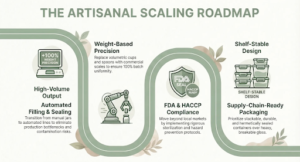
Taking a beloved family recipe to the commercial market is an exciting milestone. However, an influx of wholesale orders will quickly expose the limitations of your home kitchen. Filling and sealing mason jars by hand is charming but highly inefficient for mass production.
When your artisanal sauce or homemade spice blend gains traction, filling and sealing containers by hand quickly becomes a critical operational bottleneck. To meet wholesale retail demand without compromising product consistency, food entrepreneurs must eventually transition from manual kitchen operations to automated production lines.
Upgrading to professional LevaPack allows growing businesses to systematically scale their filling, seaming, and labeling processes. This ensures that output exponentially increases while maintaining strict airtight quality control.
Relying on manual labor for large batches increases the risk of contamination and human error. Transitioning to automated systems protects your brand’s reputation and your profit margins.
Standardizing Your Winning Recipe for Mass Production
A recipe that works flawlessly for a family dinner might fail when multiplied by fifty. Standardizing your formula requires transitioning from volumetric measurements (cups and spoons) to precise weight metrics (grams and ounces).
Just like when you are perfecting a complex recipe such as our previously shared Ultimate Spicy Habanero Hot Sauce, consistency is everything. You must meticulously document every single ingredient’s weight to ensure batch uniformity.
- Convert to Weights: Buy a digital commercial scale and weigh every solid and liquid ingredient.
- Adjust Seasonings: Spices do not always scale linearly. You must test and tweak to avoid overpowering flavors.
- Consider Preservatives: Shelf-stable foods often require natural or synthetic preservatives to prevent spoilage.
If you are scaling up something robust, much like our Classic Hearty Beef Stew base, managing pH levels and water activity becomes non-negotiable. Partner with a food scientist to adapt your recipe for long-term retail storage.
Sourcing Commercial Kitchen Space & Co-Packers
You cannot legally manufacture wholesale food products from a standard residential kitchen. Finding the right certified production space is the first major step toward regulatory compliance.
- Commissary Kitchens: These are shared, rentable commercial spaces. They are ideal for startups needing professional equipment without a long-term lease.
- Private Commercial Facilities: Leasing your own space gives you total control over production schedules and equipment layout.
- Co-Packers (Contract Manufacturers): If demand outpaces your physical capacity, you can hire a third-party manufacturer to produce your food.
Working with a co-packer allows you to focus purely on marketing and sales. However, it requires handing over your proprietary recipe and trusting their quality control protocols.
Packaging Design and Retail Shelf Appeal
Your packaging must serve a dual purpose: catching the consumer’s eye and surviving the grueling retail supply chain. Glass jars are aesthetically pleasing but heavy and prone to breakage during transit.
Retail buyers care deeply about how your product fits onto their store shelves. They prefer packaging that is uniform, stackable, and space-efficient.
- Durability: Packaging must withstand drops, temperature fluctuations, and rough handling.
- Anti-Leak Security: Tamper-evident seals and hermetic closures are mandatory for retail environments.
- Visual Branding: Use high-contrast labels and clear typography to stand out in a crowded supermarket aisle.
Switching to commercial-grade tins, cans, or durable pouches often reduces shipping costs. Always consult with retail buyers about their specific packaging requirements before ordering materials.
Navigating Food Safety Standards and FDA Compliance
Scaling your food business introduces strict legal liabilities. Food safety is the absolute baseline for entering any retail channel, ensuring consumers are protected from foodborne illnesses.
Before your products can legally sit on grocery store shelves across the country, they must pass rigorous health and safety inspections. Commercial retail demands a much longer, stable shelf life than a typical local farmer’s market run.
It is absolutely imperative to familiarize yourself with federal regulations; for example, adhering to the FDA’s strict guidelines on food safety and commercial packaging dictates everything from required sterilization procedures to ingredient tracing.
This ensures your scaled-up product remains safe for nationwide consumers. You will need to implement a HACCP (Hazard Analysis Critical Control Point) plan to identify and prevent potential safety hazards.
Key Takeaways
| Area | Key Takeaway | Impact/Data |
| Recipe Scaling | Weigh all inputs | Ensures uniformity |
| Production Line | Deploy LevaPack | Boosts safe output |
| Retail Packaging | Use stackable tins | Cuts shipping costs |
| Food Safety | Adopt HACCP plan | Passes FDA audits |
Conclusion
Transitioning your artisanal product from a home kitchen to commercial retail is a demanding but deeply rewarding journey. Success requires standardizing your recipes, upgrading your packaging systems, and maintaining flawless regulatory compliance.
By investing in the right automated equipment and commercial facilities, you can confidently scale your operations. Take the leap, protect your quality, and prepare to see your brand on shelves nationwide.