Home Blog Page 116

Curried Green Zebras

The tomatoes! And while I’m on the subject of tomatoes…oh how I loved him (R.I.P). He was so beautiful, inside and out. Ahem.

Ok, so back to this curry pickle: I used zebras, who happen to be green even when they’re ripe. But, for this you want green – as in unripe – tomatoes. The fleshier the better. Little zebras or any kind of paste tomato will work well.

Curried Green Zebras

2 & 3/4 lbs. green tomatoes, sliced no larger than 1/4 inch thick
1 medium white onion, sliced very thin
2 & 1/2 tablespoons sea salt
3 cups cider vinegar
1/2 cup light brown sugar
2 & 1/2 teaspoons curry powder *
1 inch fresh ginger root, peeled & thinly sliced
12 whole allspice berries
pint mason jars with 2-piece lids
yield: approximately 4 pints


Day 1
1. Place sliced tomatoes and onions in large bowl, gently toss with sea salt. Cover lightly with kitchen towel, let stand for 8 hours or overnight.

Day 2
1. Prepare canning pot, jars & lids. No need to sterilize the jars as once filled they will be boiled 10 minutes.

2. Drain the tomatoes and onion, rinse with cold water and drain once more.

3. Place vinegar, sugar & curry powder in a non-reactive (stainless or enameled iron) pot and bring to a boil.

4. As soon as the vinegar mixture reaches a boil, add tomatoes & onions. Bring back to a simmer and let simmer, stirring gently, until all the vegetables are just heated through, approximately 2 minutes.

5. Remove hot jars from the canning pot and place 3 allspice berries & 2 slices of ginger in each jar.

6. Fill jars, leaving 1/2 inch headspace. Hot water bath process for 10 minutes.

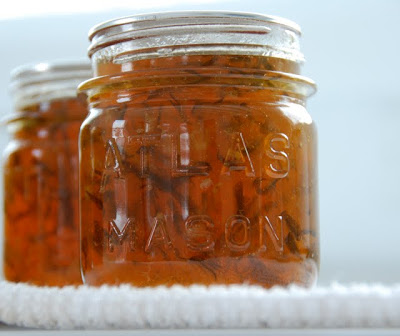
Crunchy, curried & slightly sweet. To me this is a classic canned pickle. A wonderful way to use up a glut (yes a glut!) of summer tomatoes. Delicious on a grilled cheese, or any other sandwich in which the classic bread and butter is the norm. The curry & spices add a punch but don’t overpower. Plus it looks so damn cute in a jar.

Learning: had a little packing problem at first. Make sure to scoot them in tightly before pouring in the brine to fill.


Can Jam Round-Up August: Tomatoes

Tomatoes, tomatoes, tomatoes! For many, the king of vegetables (even though we all know it’s a fruit, don’t we?)  Grown for putting up.

Just as the mighty tomato straddles the veggie-fruit kingdoms, it also straddles the level of acidity needed to safely water bath can. A lot of old recipes don’t add acid before hot water bath canning, but modern times call for such measures. So if you’re trying this at home, make sure to use a source that follows the current USDA guidelines. Or go straight to the source yourself.

crushed tomatoes – bigger than a breadbox I hope you’ll be thinkin’ of me during the winter when you sit down to a nice hot bowl of tomato something-or-other!

crushed tomatoes – wine book girl ooh! Bloody Mary with homemade tomato juice and dilly beans. Yikes! Thanks for that – I’m in trouble.

tomatoes packed in water – Rufus and clementine ya see nik (I do see that you saw) when it comes to tomatoes simple is usually better. There’s time to get fancy when you open the jar.

ketchup – market life sf very good tip on subbing in some cherries, and the fennel looks like a nice addition. Can you taste it in the finished product?

ketchup – putting by more homemade ketchup! You people are all caught up in the ketchin’ up! Sounds like it was a hit, and just a little less celery seed next time! And this just in: bbq sauce!

orange tang ketchup – hip girl’s guide to homemaking this ketchup is gorgeous! The color, and I am so down for small batch anything miss kickass! (Oh, and peeps, watch the clip!)

spicy ketchup – locally preserved this looks nice, immersion blenders are where it’s at, no? …and I like the spice! 🙂

tomato ketchup – what Julia ate if I had a jar of this it would be all over my scrambled eggs! What? Yeah right, like you don’t. 😉

Sour Cherries: Two Classic Preserves

You need to run, run I tell you! Get to your closest farm, stand, market or u-pick and get yourself some sour cherries. Now! Giddy up!

Go! Ok, now that that’s taken care of, stuff a few in your mouth, and a bunch more into a pie or two. Now, get dem in de jars! ‘Cause when winter whitewashes over you and your town, you can take a woolen-socked jaunt into your larder and pull out one of these babies.

And when you pop one open and let the glory of summer do cartwheels in your mouth you can say, “thank you.”

Or, you can forget you ever knew me and collapse in the deliciousness of it all. Take your pick.

Simple Sour Cherries

adapted from Urban Pantry

For every 4 pounds of sour cherries you will need:

6 cups water
scant 1 cup sugar (I use raw)
1 pint mason jars

Yield: each pound of fruit makes approximately 1 pint of simple sour cherries.

Prepare jars and canning pot for hot water bath processing. You do not need to sterilize jars as you will be processing the filled jars for 25 minutes.

1. Rinse, then pit cherries. I definitely recommend this or other some-such contraption. Take care to keep cherries as intact as possible.

2. Heat water and sugar on low in a small saucepan. Once sugar has completely dissolved, turn the heat up and bring to a boil. Once boiling, return heat to low and simmer until ready to use.

3. Fill jars with raw cherries. Tap the jars firmly on a towel covered counter top, and fill them again. Continue to do this until you can get not one more cherry in the jar with a 1/2 inch headspace.

4. Place 6 cherry pits in each jar; this lends a very slight bitter almond flavor. Pour any remaining cherry juice at the bottom of the bowl evenly into jars. Top with syrup, making sure to leave a solid 1/2 inch headspace. Tap the jar again to release air bubbles and top with syrup if needed.

5. Seal jars and hot water bath process for 25 minutes.

Sour Cherry Preserves

adapted from Put ‘Em Up 

For every 3 pounds of sour cherries you will need:

1 cup sugar (I use raw)
1/4 cup lemon juice
1/2 pint or smaller mason jars

Yield: each pound of cherries makes approximately 1 cup of sour cherry preserves.

Directions

  1. Prepare jars and pot for hot water bath processing. You do not need to sterilize jars as you will be processing the filled jars for 10 minutes. Place 2 or 3 small saucers in the freezer.

2. Rinse, then pit cherries. Note: remember to wear old dark clothes or a huge apron (or even nothing at all! Shhh!)

3. Place cherries in a non-reactive pot (stainless steel or enameled iron) and crush about 1/2 of them in between fingers to release their juice.

4. Add sugar and lemon juice; heat on low until the sugar has completely dissolved. Turn up the heat and boil for approximately 20-25 minutes, or until desired set has been reached.

To test for set: take off the heat. Place a teaspoon full on a frozen plate. Place plate back in freezer for one minute. Take out of freezer and push tip of finger through preserves. If it wrinkles under the finger even a little bit it is set. If you finger slides right through with absolutely no resistance, boil for one minute longer. Repeat again as necessary.

5. Seal jars and hot water bath process for 10 minutes or jar and put directly into the fridge.

These sour cherries were so tasty, so perfectly cherry-like that I couldn’t bear to add anything more to the mix. My main goal with both was to preserve that lusty cherry taste. The jam delivers, completely. It’s mouth-puckering with just enough sweetness to woo a slice of toast and butter.

For more preserves recipes just click here.

Confiture de Vieux Garçon

If you would like to make your very first confiture de __________, then let’s do it! ‘Cause really, can you ever have enough fruit in alcohol layin’ around?

To start you need either a fermenting crock with a lid to keep air out like the one I just ordered

gap

Or you can use a european glass canning jar with gasket & lid.

You want a vessel that is pretty much airtight but that will also allow for the venting of fermentation gases. Size matters too; if you really want to get through the summer adding as many different types of fruit as you can, then try to get at least 1/2 gallon, or even a gallon or more. Finally, you should keep the fruit in the dark. I mean if they ask, you can tell them what’s going on.

But if you’re using a glass vessel keep it in a larder or pantry during the making of. If you are using a ball jar with screw cap, do not screw the cap on too tight because you need to allow gas to escape.

To make confiture de vieux garçon start with a layer of fruit, then cover with a layer of sugar. The traditional recipe requires an equal sugar to fruit ratio, and I’ve seen recipes that require half the weight of sugar to fruit. I’ve also read that it works with less as long as each layer of fruit is covered with sugar when added. I’m going to go with covering the fruit and not bothering with weighing. The sugar should be a fine-grained sugar so the grains are sure to dissolve.

gap

Then cover well with your chosen kirsch, cognac or brandy (you could also use rum). Put the lid on and store in a cool place. Repeat this process with each newly in-season fruit throughout the summer (or fall). When the final fruit is added, fill the container with alcohol to 3/4 inch from the top and let sit in a cool place for at least 3 or even 6 months before eating.

To avoid spoilage or mold it is important to use top-quality fruit free of bruises or sore spots, and dried completely before adding to container. Place each new layer on top and never stir, making sure sugar & alcohol cover the fruit completely.

Traditional fruits used are berries of all kinds; strawberries, raspberries, cherries, gooseberries, currents and grapes too.

If you know where your fruit’s been, do not wash raspberries, currents or gooseberries. remove stems, stalks, and tails respectively of strawberries, currents, grapes & gooseberries, but leave the cherries be with their stems and pits intact.

If you can find very small plums & gages you can leave them whole and add them with their stones and all. Otherwise quarter them and remove the stone. Quarter apricots and always remove their pits.

Skin, stone and quarter peaches & nectarines. Pears should be skinned, pitted and thickly sliced.

Any combination of fruit will work, but citrus is a no-no. I’ve read not to over-do the strawberries or they will dominate and I’ve also read not to add ‘foreign’ fruit. Which I’m assuming means things like papayas, mangos and the like.

Rhubeena

Yes, I’m still workin’ on preserving all that rhubarb… This is a new one for me and I’m quite excited about it.

The very cool thing is that you can make ‘beenas all summer with each new fruit as it bursts into season. That means by the end of the summer you can have a tidy little ‘beena selection tucked away in your larder. And throughout the year, whenever the spirit moves you, you can enjoy the tastes of summer! Simply dilute to taste with spring or sparkling water.

…That’s assuming of course that you have any left after all of the cocktail parties you’ll be throwing all summer once you are moved to put a little spirit in the mix. Simply dilute spirits to taste with rhubeena.

Know what I’m sayin?

Rhubeena

4 1/2 pounds rhubarb, chopped into 1 inch pieces
3-4 cups sugar (approximately)
jelly bag and strainer, or tight-weaved cheesecloth or butter muslin & strainer
canning bottles or jars
yield: approximately 1 & 1/2 quarts

Directions

1. Add chopped rhubarb & 1/2 pint water to a non-reactive pan. Heat on medium, partially covered, and bring to a simmer. Let simmer until all the rhubarb has softened – about 45 minutes.

2. While rhubarb is cooking place jelly bag or cheesecloth in a small pan of water and bring to a boil. Let boil for 10 minutes to sterilize.

3. Once sterilized squeeze excess water from jelly bag and place on stand over a large bowl. If using cheese cloth, place over a strainer propped over a bowl. Place cooked rhubarb in cloth and let drip overnight.

4. Next morning prepare your jars & canner. While jars are heating, measure the rhubarb liquid. For every quart of juice add a scant 3 cups of sugar.

5. Warm the juice & sugar mixture on low heat until the sugar has melted. Turn the heat to medium-high and bring to a boil. Boil for one minute.

6. Fill jars and hot water bath process for 10 minutes.

To skip the hot water bath preserving, rhubeena can be placed directly in fridge upon cooling. However, for longer shelf life in the fridge, I recommend sterilizing the jars by boiling them for 10 minutes before filling.

Note: when hot water bath preserving rhubeena, the headspace should be 1/2 inch. Don’t be fooled by the little bubbles that are on top when you place the hot liquid into jars, as apparently I was.

They appear to have sealed just fine, but sometimes with too much headspace the keeping time is cut short because not all the air has been expelled.

Quick Kohlrabi Pickles

Just when I felt the need to confess my lack of jar filling over the past few weeks over here I had an epiphany in the kitchen. Well, not quite an epiphany but you get the point – I put something in jars.

We’ve been making a lot of quick stir-fries over the last couple of weeks, having found ourselves with a lot of greens and a desire to cook them up as fast as possible and get outta the kitchen (yes, ’cause we can’t stand the heat). On one such night I saw M searching around the refrigerator shelves exclaiming, “this stir-fry needs a crunchy pickle, what do we have?”

I was like (ahem) ”nada.” Peeps, I have a reputation to uphold, and even though you dear readers are the forgiving type (and M is too, of course) there is just something wrong in my world if my husband comes out of the fridge or larder pickleless!

So you know, I went out to the garden and deftly slayed 3 pounds of kohlrabi. Then went down into the cellar and got my paws on an empty half gallon jar. This is what I did:

Quick Kohlrabi Pickles

My Favorite Preserved Lemons

I can’t possibly go through a citrus season without making a batch of these.

And you shouldn’t either. I know everybody does the kind with just salt. maybe a bay leaf or a clove or something. Boring.

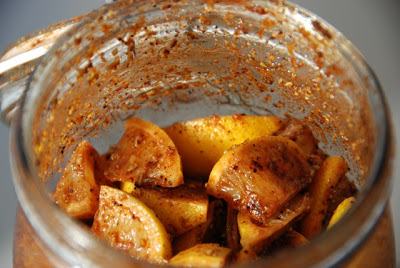
It may look like a lot of spices but they mellow during the preserving process. The spices sink into the background and form the perfect basis for a salty citrus pop.

And you’re left with a preserved lemon that is going to send you over the moon, and go perfectly with everything that you could possibly imagine using a preserved lemon for.

Trust me. Do this.

My Favorite Preserved Lemons

adapted from World Vegetarian by Madhur Jaffrey

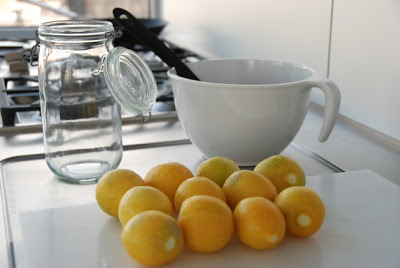
2 pounds organic lemons (preferably not Meyer)
juice of 3 lemons
9 tablespoons sea salt
1/2 teaspoon seeds of brown cardamom (you can substitute green)
1 teaspoon black peppercorns
1 teaspoon cayenne (or paprika, or half of each)
16 whole cloves
1 & 1/2 tablespoons sugar (i use raw)
1 half gallon jar with screw cap, washed with hot soapy water & dried completely

Directions

1. Wipe lemons with a damp cloth or paper towels, then wipe dry. Leave to dry completely for an hour or so. To prevent mold there must be no water on lemons or inside of jar.

2. Grind peppercorns, brown cardamom seeds and cloves in a spice grinder or mortar and pestle. Note: only the seeds of the cardamom should be used. To extract seeds from pods, crush pods with end of pestle, discard shells.

Stir the ground spices with salt, sugar and cayenne. I advise using the whole 1 teaspoon of cayenne even if you are not a heat lover as it is such a small amount, the lemons will not taste hot. But if you really do not like even the slightest bit of cayenne than go for the paprika. Set aside.

gap

3. Thinly slice off the button end of each lemon. Slice each lemon into quarters. If you are working with very large lemons you may want to cut some of the quarters in half again. Remove seeds.

4. Place quartered lemons in a large bowl, add spice mixture and toss to coat. Fill 1/2 gallon jar with lemons, add the juice of 3 lemons and screw cap on.

5. Place on a sunny windowsill for 4-6 weeks. Shake once a day, or turn upside down, and right side up again once a day if you are confident the lid won’t leak. For the first couple of weeks unscrew the top gently every two days or so to release fermentation gases.

Depending on how thick your lemon peels are, the preserved lemons will be ready to eat within 4 to 6 weeks. Begin to test at the 4 week mark; lemons are ready when peels are still slightly firm but soft enough to sink your teeth into. When you deem them soft enough, store in the fridge for up to a year or more.

To eat, scoop out a lemon quarter or two, rinse under cold water and discard the lemon flesh. Chop to use in soups, stews, tangines, salads, and all manner of bean or rice dishes. Once you get a taste for these, there is nowhere you won’t want to use them.

Pickling Carrots Safely

What can I do to insure that the carrots’ hot water bath process does not kill me or my loved ones?

There’s exactly two things that will prevent this from happening:

1) You will boil the jars long enough to kill the clostridium botulinum vegetative cells.
2) The food in the jars is acidic enough to prevent the clostridium botulinum spores from germinating into cells.

Clostridium botulinum bacteria has two forms: vegetative cells – these produce the killer toxin, and protective structures called spores. When we boil the jars for the properly allotted time, we kill the cells, but the spores survive. In a favorable environment, the spores will germinate into the vegetative cells that produce the deadly botulinum toxin.

Here, let me break it down for you: clostridium botulinum is a common microorganism in soil all over the world. There’s no problem with it when it is exposed to oxygen. But when conditions are favorable for it to thrive, it can become deadly. What are the conditions?

No air and low acidity.

Since we are forcing the air out of the jars when we hot water bath can (i.e. creating a very favorable environment for germination), it is imperative that the acid level is high enough to prevent this from happening.

Got it?

So when hot water bath canning low-acid foods (veggies not fruit), you will most likely be making pickles or chutneys and this is my advice to you:

1) Use a reputable source written or updated 1995 or later – or check with the USDA.
2) Never vary the amount of vinegar, water or vegetables in the recipe (herbs, spices, salt & sugar are okay).

gap

3) Use vinegar that is 5% acidity or higher (it’s marked on the label). Homemade vinegars are not ok because acidity level is unknown.
4) Never boil the vinegar mixture longer than the recipe states.

If you are a newbie pickler, I would also caution against switching out types of vegetables in the recipe because boiling time differs for different veggies. In mixed pickles, you should set the boiling time for the vegetable that requires the longest amount of boiling time.

I would also not be in a rush to purchase a pH meter. A pH level of 4.6 or lower prevents the germination of spores, and pickling recipes from reputable sources fall way within the realm of safety, usually within the 2.6 – 4.0 range. So if you follow the recipe exactly as outlined above, you got nothin’ to worry about. Plus you’ll either have to wait 3 weeks after canning the pickles, or puree one whole jar of food before you can it to test accurately.

Quince in Rose Syrup

I wanted to preserve the wonderfully alluring nature of quince to enjoy throughout the year without a whole heck-of-a-lot of embellishment. I looked to quince’s native home for inspiration: Persia, Turkey and their surrounds.

Quince in Rose Syrup

Yield: 4 pints

4 lbs. quince
juice of 2 lemons
2 & 1/2 cups sugar
approximately 20 black peppercorns
1/4 cup rose water
pint mason jars

1. Prepare the canner and jars for hot water bath processing. No need to sterilize as you will be processing for over 10 minutes. Just make sure they are hot when you fill them.

2. Prepare a large bowl with cold water. Place 4 cups water in a large saucepan and add the quince whole. Bring to a boil for 2 minutes. Take quince out with slotted spoon and drop in cold water. Reserve the 4 cups water in the saucepan.

3. Remove quince from the bowl, and refill with fresh cold water; add juice of two lemons.  Peel, core and cut quinces into eighths. Drop directly into lemon-water to avoid discoloration.

4. Add sugar to the reserved 4 cups of water in pan and heat on low until sugar is dissolved. Add quince slices and bring to a boil. Simmer gently for 12 minutes, partially covered. Turn off heat.

5. Remove all 4 pint jars from canning pot. Add 5 whole black peppercorns to each. Remove quince from syrup with a slotted spoon and fill each jar with quince to 1/2 inch headspace. Tap the jars on a towel covered counter to create more space and release air.

6. Add 1/4 cup rose water and return syrup to a boil. Once boiling, turn off heat and pour over fruit into jars, leaving 1/2 inch headspace. Use a plastic chopstick or plastic knife to gently remove air bubbles.

7. Hot water bath process for 20 minutes.

gap

Though I know that rose water is heavily used in Persian and Turkish sweets, there was a moment when I thought it may be too sweetly perfumed for the quince’s heady scent. Alas, the rose and quince do not compete; rather they marry together to form a harmonious bouquet of exotica. On ice cream this is a no-brainer, but I have something else in mind: a rose n’ quince tarte tatin or custard tart will most definitely find its way out of a couple of these jars sometime in the cold winter months.

With this recipe I came away with about 3/4 of a pint of syrup left. The scent is incredible alone, and I cannot wait to use this rose n’ quince syrup in a holiday cocktail.