
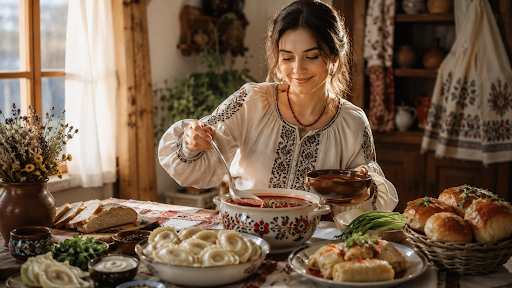

Food as a Love Language in Ukraine
There’s a saying in Ukraine that gets repeated so often it stopped being a saying and became a rule: “Гість у дім — Бог у дім.” A guest in the house is God in the house. And God, apparently, needs to eat. A lot.
If you’ve ever visited a Ukrainian home, you know what happens. You say you’re not hungry. Nobody cares. A plate appears. Then another one. Then someone’s aunt brings out the “small snack” which is somehow a full roast chicken with three salads. Refusing food isn’t rude exactly, it’s just… pointless. You will eat. Everyone eats.
This isn’t about showing off. Ukrainian hospitality grew out of centuries where a full table was never guaranteed, so offering one became the loudest possible way to say you matter to me. Feeding someone is the default expression of care — for guests, for children, for a husband coming home late, for the neighbor who helped fix the fence. Words are fine. Food is proof.
And here’s the thing most food writing about Eastern Europe misses: the person running this whole operation is almost always a woman. Grandmother, mother, daughter — a relay of hands passing down not just recipes but an entire philosophy of what it means to take care of people. Understand the kitchen, and you understand a huge part of Ukrainian womanhood. Honestly, maybe the biggest part.
The Dishes Every Ukrainian Woman Learns at Her Grandmother’s Table
Some skills in Ukraine are optional. Making borscht is not. Even today, when a woman in Kyiv can order Thai delivery in twenty minutes, being able to cook the family classics carries real cultural weight. It comes up at family gatherings, it comes up when meeting a partner’s parents, and it comes up — no joke — on dating profiles. Men on Ukrainian brides dating platforms regularly mention that the women they meet talk about their signature dishes with the kind of pride other people reserve for career achievements. Cooking isn’t seen as a chore there. It’s a flex.
So what exactly does a Ukrainian girl grow up learning? Three things, mainly.
Borscht — and Why Every Family Swears Theirs Is the Only Correct One
Let’s get one thing straight: borscht is Ukrainian. UNESCO said so in 2022, adding Ukrainian borscht culture to its list of intangible heritage, and the entire country exhaled at once.
But agreeing that borscht is Ukrainian is where the agreement ends. West of the Dnipro they might add beans. In Poltava, dumplings called halushky go straight into the pot. Some families insist on pork ribs, others on beef, a few heretics use chicken. Green borscht with sorrel exists and is a completely different dish that shares a name. The beet question alone can end friendships — how dark, how sweet, whether you sauté them first or add raw.
Every family recipe is “the real one.” Every grandmother’s version is unbeatable. A young woman learning borscht isn’t learning a soup — she’s inheriting a position in an ancient argument, and she will defend it for life.
Varenyky and the Ritual of Making Them Together
Varenyky are half-moon dumplings, and they’re where Ukrainian cooking turns social. You can’t make two hundred of them alone. Well, you can, but why would you, when the whole point is three generations of women around one table — someone rolling dough, someone cutting circles, someone spooning filling, and the youngest one pinching edges badly while everyone pretends her lopsided dumplings are perfect.
Fillings run the full range. Potato with fried onion is the workhorse. Cottage cheese, sweet or salty. Cabbage. And in summer — sour cherries, served with sugar and thick cream, which sounds strange until you try it and then you’re ruined for other desserts.
The gossip that happens over varenyky dough is its own institution. Recipes get traded, marriages get discussed, family history gets told in fragments. I think this is where the real transmission happens, more than any formal teaching.
Holubtsi, Salo, and the Everyday Table
Beyond the famous dishes sits the daily repertoire. Holubtsi — cabbage rolls stuffed with rice and meat, simmered slow in tomato sauce until the cabbage nearly melts. Deruny, crispy potato pancakes with sour cream. And salo — cured pork fat, sliced thin on dark bread with garlic, which foreigners fear and Ukrainians treat as a national treasure. There’s a whole genre of jokes about salo. Most of them are affectionate.
These aren’t Sunday showpieces. This is Tuesday food, and a woman who can turn cheap ingredients into a table people fight over — that skill is noticed and respected.
What the Kitchen Says About Character
Watch a Ukrainian woman cook and you’re watching a character study.
Patience, first. Real borscht broth simmers for hours; some cooks insist the soup only reaches its peak on day two. Nobody rushes it. Fast borscht is wrong borscht.
Generosity, obviously — the compulsion to feed everyone within reach until they beg for mercy. My theory: it’s genetic at this point.
Pride in from-scratch work. Store-bought dough is tolerated, barely, with visible suffering. Doing things properly, with your own hands, carries moral weight.
And adaptability, which people forget to mention. Young women in Lviv and Kyiv aren’t chained to the stove — they have careers, they use delivery apps, some can’t cook at all and don’t apologize for it. Tradition bends. A modern Ukrainian woman might make varenyky twice a year and order sushi the rest of the time, yet those two sessions still connect her to every woman in her family line. The tradition isn’t about frequency. It’s about knowing who you are when the dough hits the table.
Bringing Ukrainian Dishes Into Your Own Kitchen
You don’t need a Ukrainian grandmother to start. Three dishes make a realistic entry point.
Simplified borscht. Skip the multi-day broth on your first attempt — a decent beef stock cube won’t get you arrested. Sauté grated beets with a splash of vinegar to keep the color, add them near the end, not the beginning. The classic beginner mistake is boiling beets to death until the soup turns orange instead of deep red. Finish with garlic and a spoon of sour cream on top. Always sour cream.
Lazy varenyky. Real varenyky take an afternoon; lazy ones take fifteen minutes. Mix cottage cheese with an egg, a little flour, a pinch of salt, roll into a rope, cut into pillows, boil until they float. Butter, sugar or sour cream on top. Kids demolish these.
Deruny. Grate potatoes fine, squeeze out the liquid — this is the step everyone skips and then wonders why their pancakes fall apart. Egg, spoon of flour, salt, onion if you like. Fry in properly hot oil until the edges go lacy and brown. Eat immediately, standing at the stove, because they never survive long enough to reach the table anyway.
Ingredient-wise, Western supermarkets cover almost everything. Beets, cabbage, potatoes, dill — easy. For the cottage cheese, look for dry farmer’s cheese rather than the watery tub kind. And buy more sour cream than you think you need. Then double it. Ukrainian cuisine runs on the stuff, and once you start putting it on everything, you’ll understand why nobody there ever measures it.